Theme · In-depth study
Christ in Types and Shadows
How God Prepared Israel for Jesus Christ
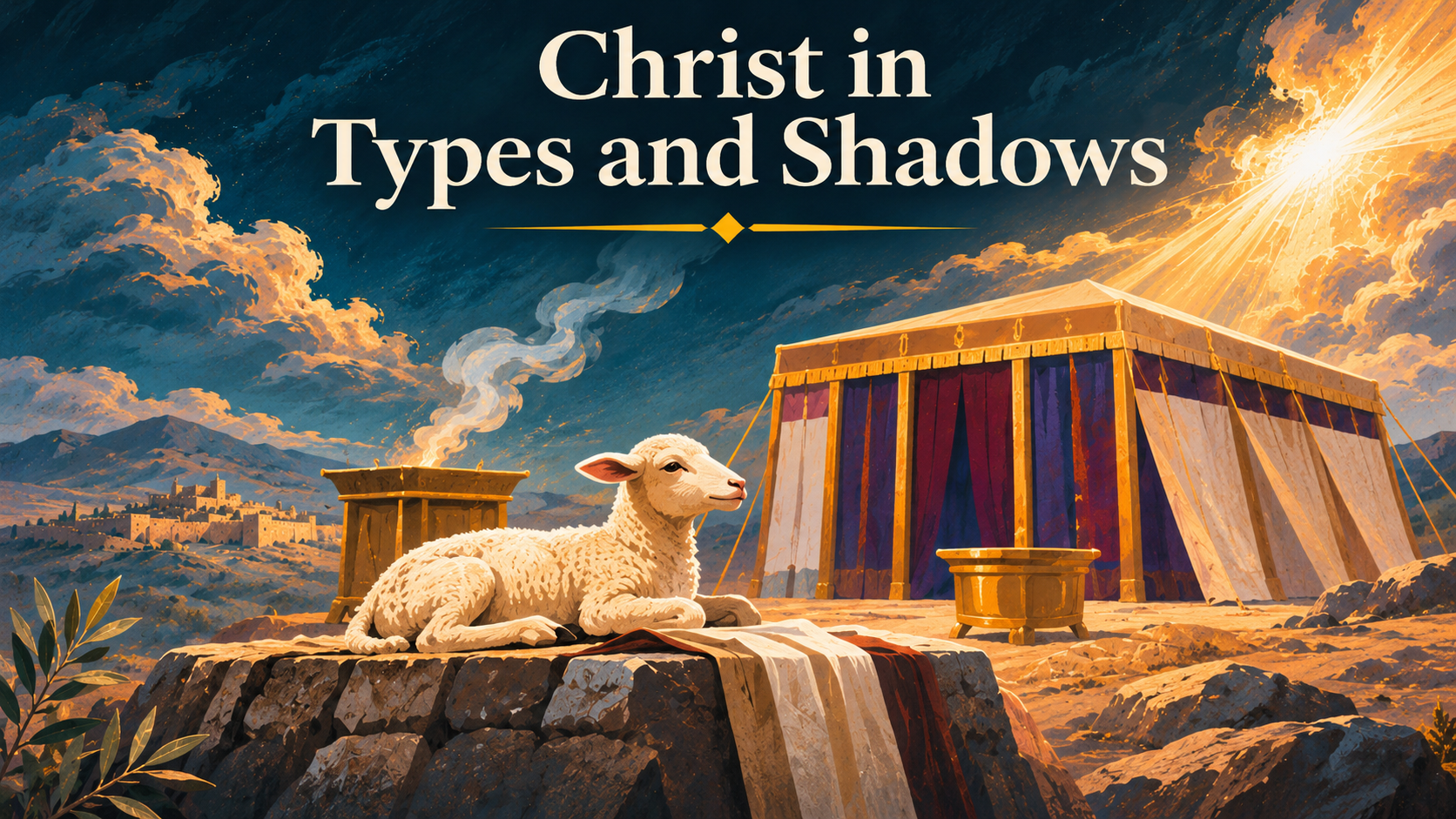
How did God foreshadow Jesus Christ through people, historical events, institutions, rituals, and patterns throughout the Old Testament?
God rescued Israel through the Passover, sustained His people in the wilderness, dwelt among them in the tabernacle, and gave them priests and sacrifices so that sinners could approach Him. These were real events and real gifts, and they mattered for the people who lived through them.
Centuries later, Jesus and His apostles showed how these events and institutions anticipated something greater. Christ is our Passover Lamb, the true bread from heaven, our great High Priest, and the one whose sacrifice brings lasting forgiveness. Even people such as Adam, Moses, and Melchizedek help us understand who Christ is and what He came to accomplish.
The central teaching
Israel’s history, covenants, priesthood, sacrifices and institutions formed part of God’s unfolding redemptive plan. The New Testament reveals their culmination in the eternal Son, whose incarnation, death, resurrection and enduring priesthood accomplish the greater reality anticipated by the shadows.
Chapter 1
What Are Types and Shadows?
When Christians say that the Passover points to Jesus, they are not saying the Exodus never happened or that its first readers should have ignored Egypt. God really delivered Israel. The New Testament then identifies that deliverance as part of a larger redemptive pattern fulfilled through Christ. Typology holds the earlier event and the later fulfillment together.
Read chapter →Chapter 2
Adam and Christ: The First and Last Adam
Romans 5 does not introduce Adam as a decorative illustration. Paul sets Adam and Jesus Christ alongside one another to explain the reach of sin, death, grace, and righteousness. He expressly calls Adam a type of the one to come, yet insists that Christ’s gift is not simply another version of Adam’s trespass.
Read chapter →Chapter 3
Abel, Seth, and the Righteous Line
Genesis 4 shows sin spreading from disobedience into murder. Yet the chapter also witnesses to worship, accountability, and the preservation of a human family through which God’s purposes continue. Abel and Seth matter in their own right before anyone compares them with Jesus.
Read chapter →Chapter 4
Noah, the Ark, and Salvation Through Judgment
The Flood narrative joins two realities that should never be pulled apart: God judges pervasive human evil, and God graciously preserves life. Noah does not save himself by navigating around judgment. God provides a way through it.
Read chapter →Chapter 5
Abraham, Isaac, and the Beloved Son
Genesis 22 is the climax of Abraham’s testing, not an isolated puzzle about a father and a knife. God’s promises have attached the covenant future to Isaac. The command therefore brings the gift and the promise into a terrifying tension that the narrative resolves through God’s provision.
Read chapter →Chapter 6
Joseph: The Rejected Brother Who Becomes Deliverer
Joseph’s story stretches from the fracture of a family to its survival through famine. The narrative gives sustained attention to suffering, temptation, wise administration, repentance, and forgiveness. Its meaning is larger than a checklist of similarities with Jesus.
Read chapter →Chapter 7
Moses and the Greater Deliverer
Moses is not a failed preliminary version of Jesus. Scripture honors him as the servant through whom God liberated Israel, gave the covenant, and guided His people. Precisely because Moses’ role is great, Hebrews’ claim about the Son’s greater authority matters.
Read chapter →Chapter 8
The Exodus as the Pattern of Redemption
The Exodus is the foundational rescue story of Israel: God hears an oppressed people, judges their oppressors, brings them through the sea, and binds them to Himself. Its meaning includes freedom for worship and covenant life, not merely escape from unpleasant circumstances.
Read chapter →Chapter 9
The Passover Lamb and Christ
Passover belongs first to the night God delivered Israel from Egyptian oppression. Its lamb, blood, meal, and remembrance are inseparable from judgment and rescue. The New Testament makes the christological connection unmistakable: Christ our Passover has been sacrificed.
Read chapter →Chapter 10
Manna, Living Water, and the Bread from Heaven
The wilderness exposes Israel’s dependence. Food and water are not optional luxuries, and the people cannot manufacture them through their own strength. God’s provision sustains a journey, while the commands surrounding it test whether the people will trust Him.
Read chapter →Chapter 11
The Bronze Serpent and the Crucified Christ
Numbers 21 describes rebellion, judgment, and an unexpected provision for healing. A bronze serpent is raised, and those who look at it live. John 3 gives the connection to Christ explicitly: as Moses lifted the serpent, so the Son of Man must be lifted up.
Read chapter →Chapter 12
The Tabernacle: God Dwelling Among His People
The tabernacle makes a remarkable claim: the holy God intends to dwell among the people He rescued. It also makes His holiness unmistakable. Access is ordered, purification matters, and the sanctuary is not a human technique for controlling God.
Read chapter →Chapter 13
The Priesthood and the Greater High Priest
Israel’s priesthood gives concrete form to a difficult question: how can sinful people approach the holy God? Priests do not merely organize religious meetings. They serve within God’s covenant through sacrifice, purification, teaching, and intercession.
Read chapter →Chapter 14
Melchizedek: King and Priest
Melchizedek appears briefly in Genesis, returns in a royal psalm, and becomes central to Hebrews’ account of Christ’s priesthood. The brevity of his biblical biography is part of the later argument. It should not become a license to invent a biography—or to assume that a missing genealogy proves he is Jesus.
Read chapter →Chapter 15
The Sacrificial System and the Perfect Sacrifice
Leviticus describes more than one kind of offering because Israel’s worship concerns more than one problem or response. Sin, impurity, gratitude, fellowship, dedication, and restitution all appear. Treating every sacrifice as the same payment for the same offense obscures the text.
Read chapter →Chapter 16
The Day of Atonement and the Heavenly Sanctuary
Leviticus 16 addresses the holy presence of God amid a people affected by sin and impurity. The Day of Atonement is not merely a private exercise in feeling forgiven. It purifies sanctuary and people, joining sacrificial blood, confession, removal of sins, and humbled worship.
Read chapter →Chapter 17
Joshua, Rest, and the Greater Inheritance
Joshua leads Israel into the promised land, and the book states that God gives rest and fulfills His promises. Hebrews does not erase that achievement. It asks why a later psalm still calls people to enter God’s rest if Joshua’s rest were the ultimate completion.
Read chapter →Chapter 18
Christ the Substance: The Fulfillment of Every Shadow
The Old Testament is not merely a collection of isolated predictions. It narrates real people, institutions, covenants and acts of God that become patterns within a unified saving purpose. The New Testament reveals their culmination in the eternal Son made human.
Read chapter →Why this matters forever
The patterns confront real sin, judgment and death; Christ supplies the final remedy, not merely another symbol. The salvation He accomplishes calls for faith, repentance and a life shaped by His grace.
The earlier gifts remain Scripture. Their fulfillment reveals God’s faithfulness and invites us toward the promised inheritance of life with Him.